Why Speaking Up Saves Money
The Risk That Doesn’t Show Up
There is a version of organisational risk that does not appear in the audit. It does not trigger a safety incident or generate a COID claim. It does not show up in absence data or turnover figures - at least not immediately.
It sits in the gap between when something goes wrong and when someone feels safe enough to say so.
In organisations where that gap is wide, problems grow in the dark. A hazard goes unreported because the person who noticed it does not feel confident enough to raise it. An employee struggling with mental health does not access the EAP because reaching out feels like a sign of weakness. A manager under sustained pressure does not ask for support because the culture signals that asking is a problem.
By the time any of these situations become visible, the cost is already there - spread across absence, claims, management time and lost productivity in ways that are rarely connected.
What Psychological Safety Actually Means
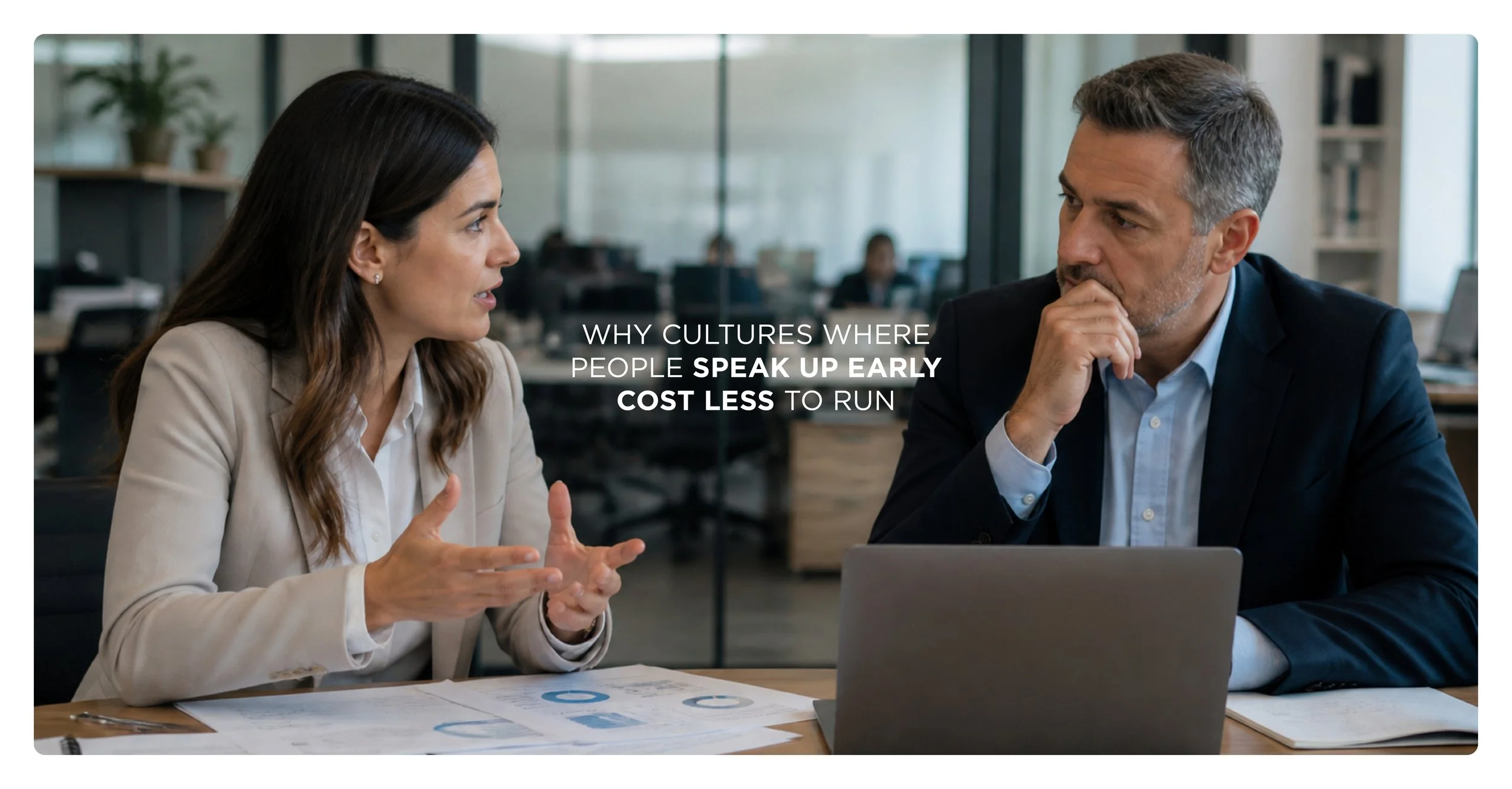
Psychological safety is often overused as a concept, but in practical terms it means one thing: whether people in your organisation feel safe to raise concerns, report problems and ask for help early rather than late.
That single variable has a measurable commercial impact.
Organisations with higher psychological safety tend to have lower incident rates — not because their workplaces are inherently safer, but because hazards are identified earlier. They have better EAP utilisation - not because the programme is better, but because people trust using it. They retain employees in high-pressure roles because people feel supported enough to manage the pressure.
Each of these outcomes carries a cost implication. Together, they shape the cost of running the organisation.
Where It Starts
Psychological safety is not something HR can install. It is set - and continuously reset - by leadership behaviour.
When leaders speak openly about stress and its management, people respond. When a CEO asks about team wellbeing and acts on what they hear, the gap between a problem emerging and a problem being raised becomes smaller. When leadership treats health programme participation as a strength rather than a weakness, early intervention becomes possible.
The opposite is also true. In organisations where wellbeing is treated as a soft priority, where programmes exist but are not supported, and where asking for help is discouraged, costs increase — in claims, absence and the management of problems that could have been addressed earlier.
The Commercial Case
This is not about removing pressure. Pressure is a feature of most high-performing organisations. The question is whether the organisation has the infrastructure to support people through it.
Accessible EAP, proactive occupational health and a culture that encourages early intervention are not simply support functions. They are part of a broader risk management system.
Organisations that get this right do not eliminate risk. They reduce the time between a problem emerging and a problem being addressed. That gap - measured in weeks or months rather than days - is where a significant portion of avoidable cost sits
If the culture in your organisation makes problems harder to raise early, that is a leadership issue worth addressing. Incon Health can help you understand what it is costing - and what to do about it.